
A clicking noise when turning is one of the most recognizable sounds in auto repair. If you hear a rhythmic click or pop as you pull out of a parking space or take a tight corner, the most likely cause is a worn CV axle joint. Here are the symptoms to look for, how to tell a CV axle noise from other common noises, and whether it’s safe to keep driving.
The short answer: a clicking or popping sound that gets louder when you turn sharply, especially at low speed, is the classic sign of a worn outer CV joint. It usually starts with a torn CV boot that lets the joint’s grease out and dirt in. It is not safe to ignore: a badly worn CV joint can fail and leave the car undrivable, so have it inspected soon.
What Is a CV Axle?
A CV axle (constant-velocity axle, also called a half shaft) is the shaft that carries power from the transmission to a drive wheel. It has a flexible joint at each end so it can keep delivering power while the wheel steers and the suspension moves up and down. Each joint is packed with grease and sealed inside a rubber or plastic CV boot.
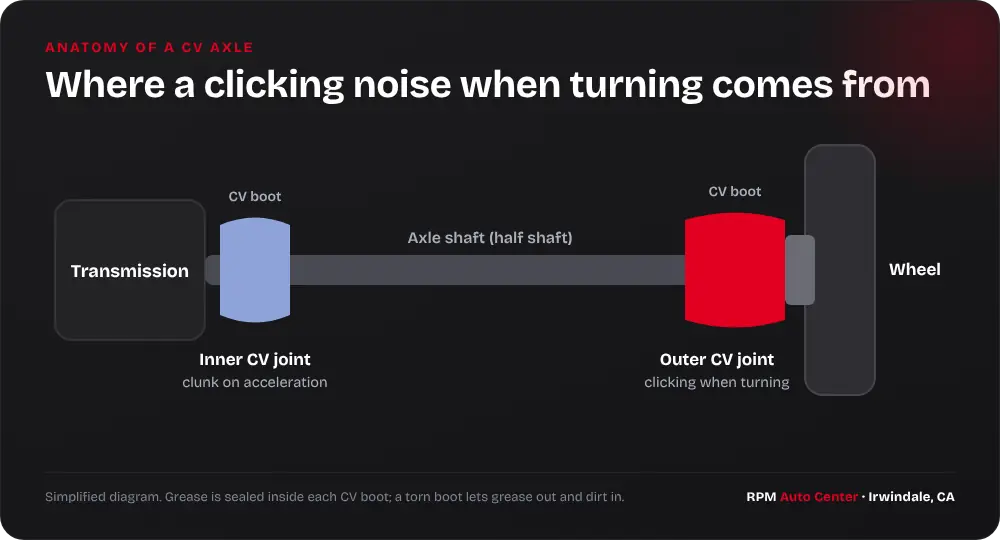
The outer joint sits at the wheel, the inner joint at the transmission, each sealed by a CV boot.
Outer CV joint
The wheel end. It works at a sharp angle when you steer, so a worn one clicks in turns.
Inner CV joint
The transmission end. A worn one is more likely to clunk on and off the gas.
CV boot
The flexible cover that keeps grease in and dirt, water and road debris out.
You’ll find CV axles at the front wheels of front-wheel-drive cars, and on many all-wheel-drive vehicles as well. That covers a large share of the commuter cars, crossovers and SUVs on San Gabriel Valley roads.
What Are the Symptoms of a Bad CV Axle?
The most common symptoms of a bad CV axle are a clicking noise when turning, a clunk when you accelerate or let off the gas, vibration while driving, and grease on the inside of the wheel or tire. Here’s what each one usually points to:
Clicking when turning
The classic sign of a worn outer CV joint. It’s usually loudest in slow, tight turns.
A clunk on or off the gas
A clunk as you accelerate or let off the gas can point to the inner CV joint, the end closest to the transmission.
Vibration while driving
Once moisture and debris get into a CV joint, it can wear enough to cause a vibration.
Grease inside the wheel
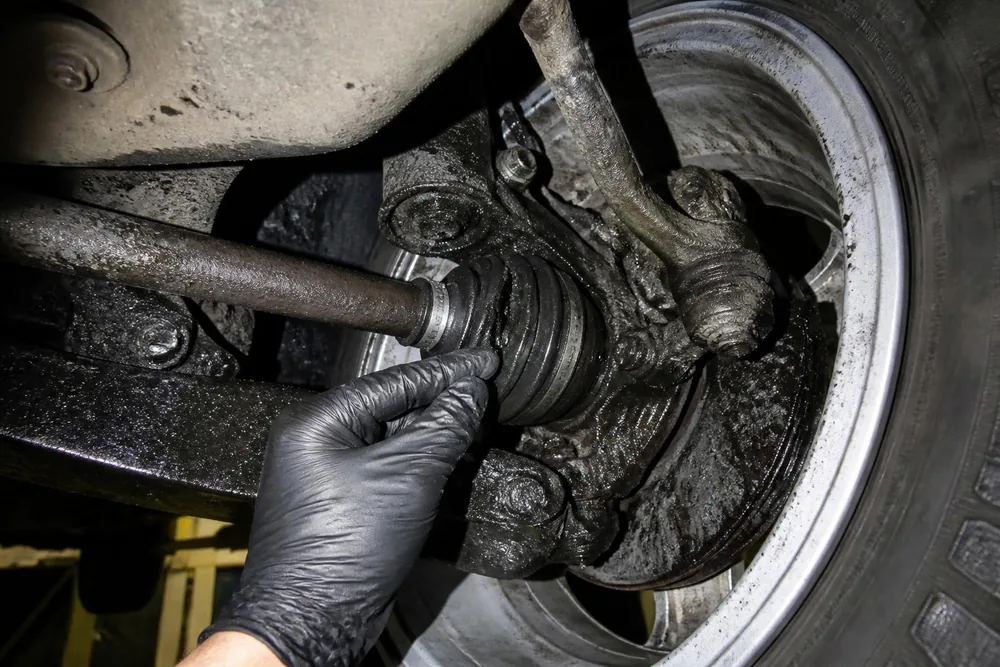
A torn boot flings grease onto the inside of the wheel and nearby parts, often before any noise starts.
Why Does a CV Joint Start Clicking?
Most clicking CV joints start with a damaged boot. The boot’s job is simple: keep the grease in and keep dirt, water and road debris out.
The boot cracks
Step 1. Over time, the rubber can crack or tear.
Grease out, dirt in
Step 2. Grease escapes and contaminants get into the joint.
The joint wears
Step 3. The joint begins to wear until it clicks or vibrates.
That’s why catching a torn boot early matters. Once a CV joint has worn to the point of clicking or vibrating, it generally needs to be replaced, since most CV joints aren’t serviceable on their own.
CV Axle Noise vs. Other Common Car Noises
Several problems can sound similar from the driver’s seat. These are the patterns technicians use to narrow it down:
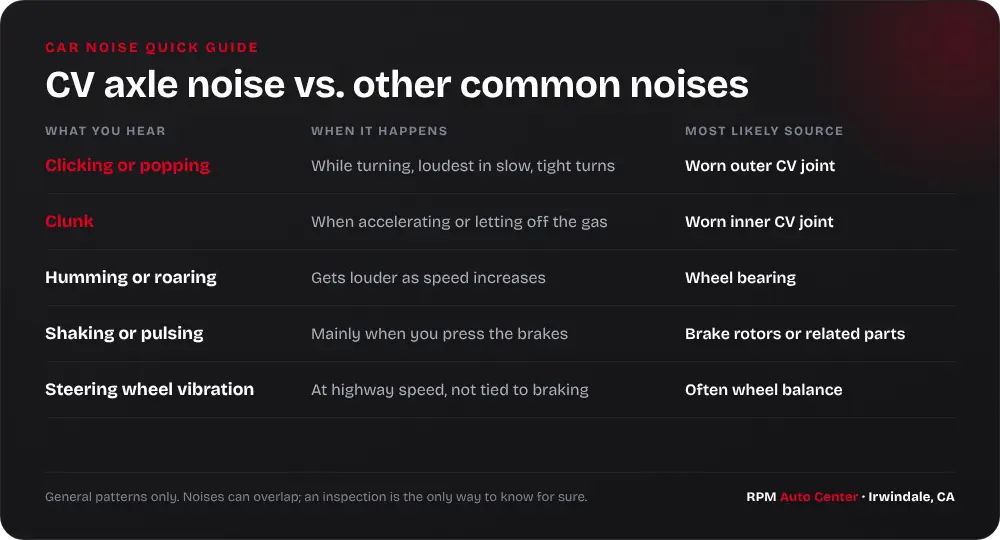
How a CV axle noise compares with wheel bearing, brake and wheel balance problems.
Clicking
When: clicking or popping while turning, loudest in slow, tight turns.
Likely source: worn outer CV joint.
Clunking
When: when accelerating or letting off the gas.
Likely source: worn inner CV joint (or other drivetrain or mount wear).
Humming
When: a hum or roar that gets louder as speed increases.
Likely source: wheel bearing. See our wheel bearing noise guide.
Shaking or pulsing
When: mainly when you press the brakes.
Likely source: brake rotors or related parts. See why a car shakes when braking.
Steering wheel vibration
When: at highway speed, not tied to braking.
Likely source: often wheel balance; worth a tire and wheel check.
Noises can overlap, and more than one part can wear at the same time on a higher-mileage vehicle, so an inspection is the only way to know for sure.
Is It Safe to Drive With a Bad CV Axle?
Not for long. A severely worn joint can break while you’re driving, which can leave the car unable to move and, in the worst case, affect your control of the vehicle.
Not safe
YourMechanic: “It is not safe to drive with a damaged CV joint.”
If you hear clicking when you turn:
- Avoid hard acceleration and sharp, fast turns until it’s checked.
- Look behind your front wheels (with the car parked and the engine off) for grease splatter or a torn boot.
- Book an inspection soon. Clicking tends to get worse, not better.
How Do You Check a CV Axle at Home?
You can do two quick checks before your appointment:
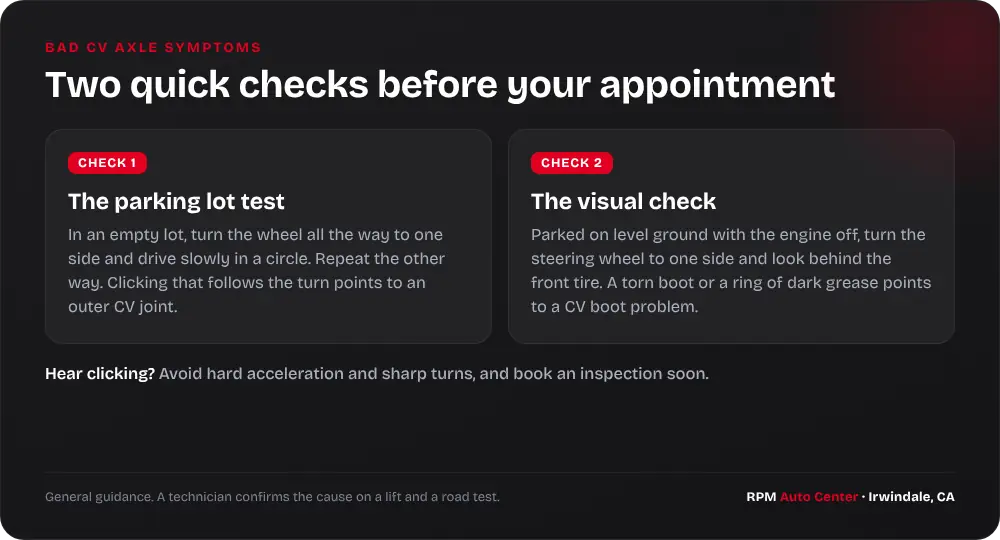
The parking lot test and the visual check, two ways to spot bad CV axle symptoms at home.
The parking lot test
In an empty lot, turn the wheel fully to one side and drive slowly in a circle, then repeat in the other direction. A clicking sound that follows the turn is a strong sign of an outer CV joint. Note which direction is louder and tell your technician.
The visual check
With the car parked on level ground and the engine off, turn the steering wheel to one side and look behind the front tire. A torn boot or a ring of dark grease on the suspension parts and inside of the wheel points to a CV boot problem.
A technician can confirm the cause by inspecting the boots and joints on each axle with the car on a lift and reproducing the noise on a road test.
Already been quoted?
Bring your estimate in and we’ll take a second look at the CV axles, boots and anything else on the list.
CV Axle Inspection and Repair in Irwindale
RPM Auto Center has helped San Gabriel Valley drivers track down clicks, clunks and vibrations since 2009, including customers from Monrovia, Arcadia, Duarte, Azusa and Baldwin Park. Our ASE-certified technicians inspect CV axles and boots as part of our suspension repair and steering repair services. Repairs are backed by our 36-month/36,000-mile warranty.
Already been quoted somewhere else? We offer a free second opinion. And if your car also pulls to one side or is wearing tires unevenly, ask us about a wheel alignment check while it’s in the shop.
Keep reading
Not sure the noise is a CV axle? These guides cover the other usual suspects.
Frequently Asked Questions
What causes a clicking noise when turning?
The most common cause is a worn outer CV joint on one of the front axles, usually after its protective boot tears and the grease leaks out. Less often, the clicking can come from other steering or suspension parts, so an inspection is the best way to confirm it.
What does a bad CV axle sound like?
A bad outer CV joint makes a repetitive clicking or popping sound when you turn, loudest during slow, sharp turns. A bad inner joint is more likely to clunk when you accelerate or let off the gas, and may cause a vibration.
Can a torn CV boot be fixed before the joint goes bad?
Catching a torn boot early is the best outcome. Once dirt and moisture get into the joint and it starts clicking or vibrating, the joint usually has to be replaced, since most CV joints aren’t serviceable. Have a torn boot inspected as soon as you spot it.
How long can you drive with a clicking CV joint?
There’s no safe number of miles. Clicking means the joint is already worn, and a badly worn joint can fail without much more warning, leaving the car undrivable. Have it inspected as soon as possible.
Is a CV axle the same as a wheel bearing?
No. The CV axle delivers power to the wheel, while the wheel bearing lets the wheel spin smoothly. A bad CV joint typically clicks when turning, and a bad wheel bearing typically hums or roars louder as speed increases.
