

How often to change spark plugs depends mostly on what kind of plugs your engine uses. Here are the typical replacement intervals by plug type, the signs your plugs are wearing out early and what happens if you put the job off.
The short answer: copper spark plugs typically need replacing about every 25,000 to 30,000 miles. Platinum plugs can last up to about 100,000 miles, and iridium plugs typically last about 60,000 to 100,000 miles or more. Your owner’s manual is the final word for your engine. Hard starts, a rough idle, misfires, slow acceleration and worse gas mileage are signs your plugs may be due early.
What Does a Spark Plug Do?
A spark plug is the part that makes the spark that ignites the air and fuel in each cylinder of a gasoline engine. It fires thousands of times a minute, and every spark wears away a tiny bit of its electrodes. Over time the gap grows, the spark gets weaker and the engine has to work harder to fire cleanly.
Makes the spark
Ignites the air and fuel mixture in each cylinder.
Wears with use
The electrodes slowly wear down with every spark.
One per cylinder
Most engines have at least one plug for each cylinder.
How Often to Change Spark Plugs, by Plug Type
How often to change spark plugs comes down to the plug material. Copper plugs wear the fastest, while platinum and iridium plugs are built to last much longer. These are the typical ranges:
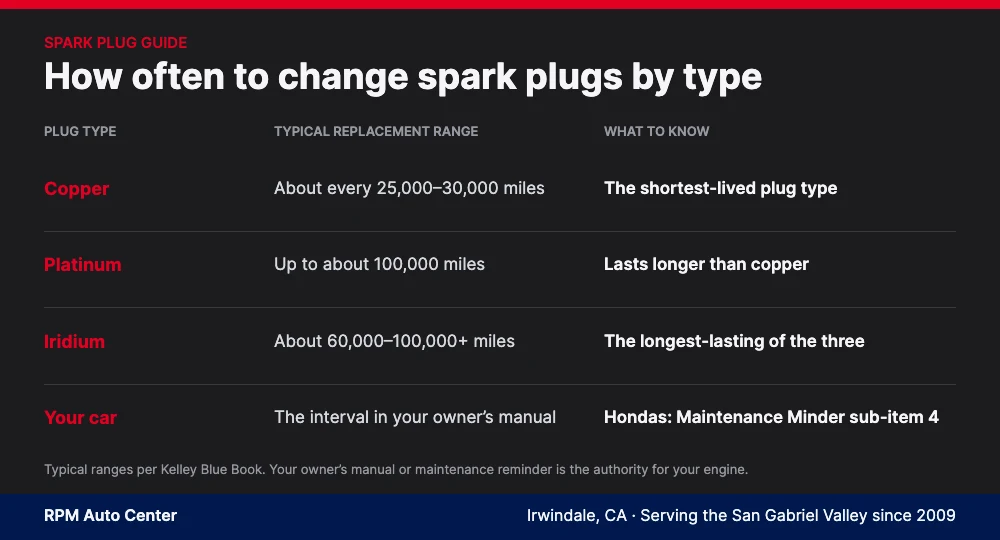
How often to change spark plugs: typical replacement ranges by plug type. Your owner’s manual sets the interval for your engine.
Copper
Typical life: about 25,000 to 30,000 miles.
The shortest-lived plug type.
Platinum
Typical life: up to about 100,000 miles.
Lasts much longer than copper.
Iridium
Typical life: about 60,000 to 100,000 miles or more.
The longest-lasting of the three.
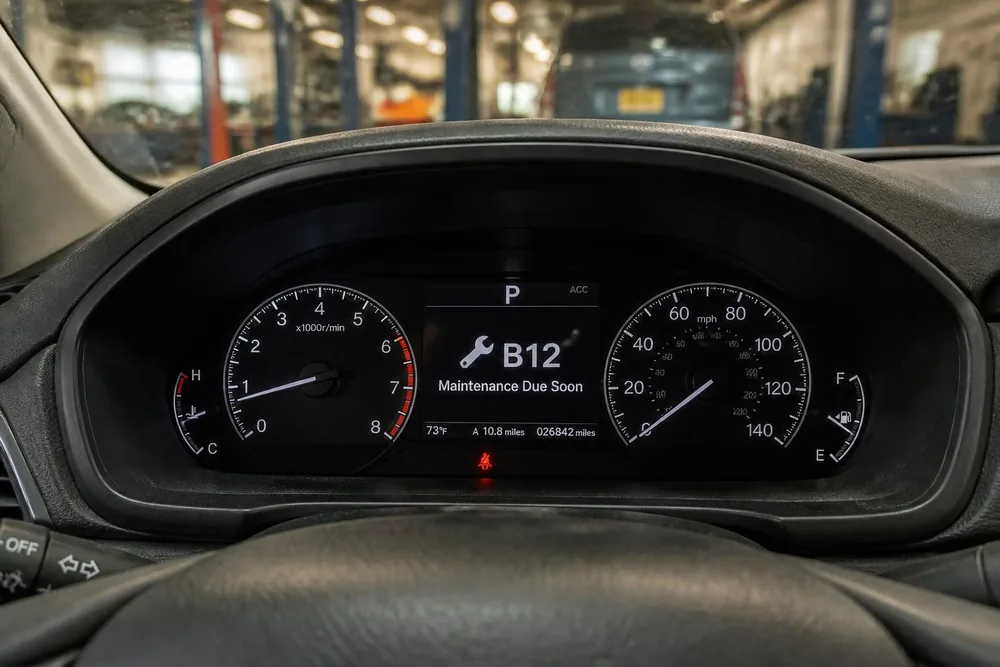
The interval in your owner’s manual always wins, because it is set for your specific engine and plug. On most Hondas, the Maintenance Minder tells you when: sub-item 4 is the spark plug service. Here is what Honda Maintenance Minder codes mean. If you’re not sure how often to change spark plugs on your car, we can look it up from your VIN.
What Are the Signs of Bad Spark Plugs?
The most common signs of bad spark plugs are hard starting, a rough idle, engine misfires, slow acceleration, worse fuel economy and a check engine light. Any of these can show up before the scheduled mileage, which is why knowing how often to change spark plugs is only half the story.
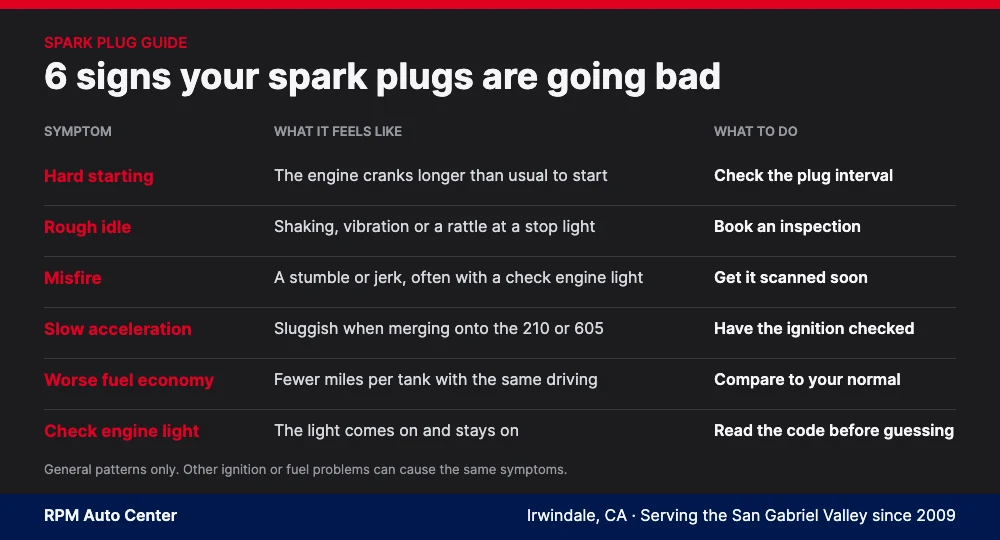
Six bad spark plug symptoms and what to do about each.
Hard starting
The engine cranks longer than usual before it catches.
Rough idle
Shaking, vibration or a rattle while you sit at a light.
Misfires
A stumble or jerk, often with a check engine light.
Slow acceleration
The car feels sluggish merging onto the 210 or 605.
Worse fuel economy
Kelley Blue Book says worn plugs can cut fuel economy by as much as 20% to 30%.
Check engine light
Worn plugs or plug wires can turn the light on.
What Happens If You Don’t Change Spark Plugs?
Worn spark plugs don’t usually fail all at once. The engine just gets a little harder to start, a little rougher and a little thirstier until the misfires begin. Putting off the job costs you in fuel and drivability, and a misfiring engine should be checked rather than driven on.
Don’t guess
Kelley Blue Book: your owner’s manual is the authority on plug intervals.
If you think your plugs are due:
- Check your owner’s manual or maintenance reminder for how often to change spark plugs on your engine.
- Note when the symptoms happen: cold starts, at idle or while accelerating.
- If the check engine light is on, have the code read before replacing parts.
- Book an inspection if the engine is misfiring.
Is It the Spark Plugs or Something Else?
The same symptoms can come from other ignition or fuel problems, so it pays to confirm the cause before replacing parts. A technician will usually start here:
Read the codes
Step 1. A scan tool shows which cylinder is misfiring. See our guide to the check engine light.
Check the plugs and coils
Step 2. Pulling the plugs shows their condition, and the ignition coils and plug wires are checked at the same time.
Look beyond ignition
Step 3. If the plugs look healthy, the next checks are fuel delivery, vacuum leaks and engine mechanical condition.
What Does a Worn Spark Plug Look Like?
A used spark plug tells a technician a lot about how the engine is running. These are the signs that a plug is worn out or that something else needs attention:
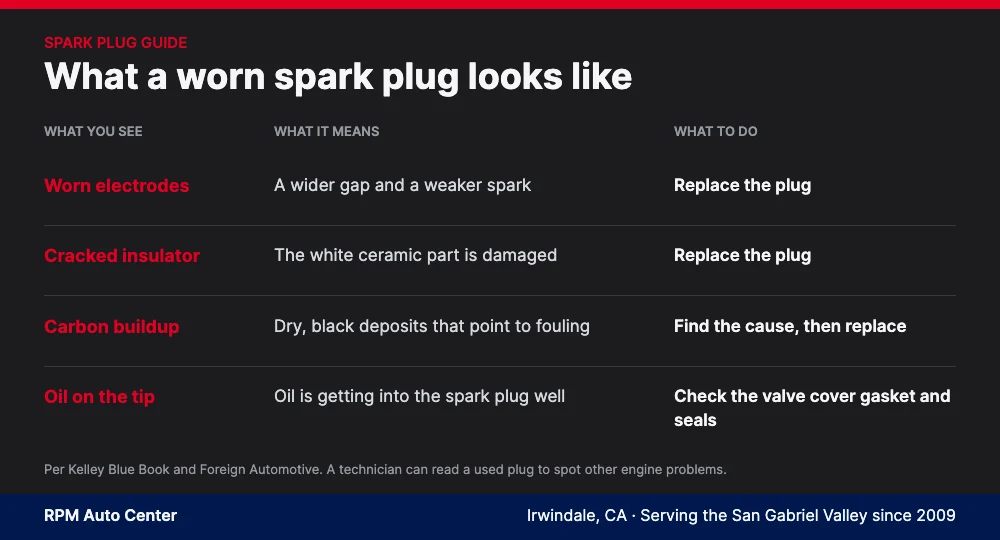
What worn electrodes, a cracked insulator, carbon and oil on a spark plug tell a technician.
Worn electrodes
Rounded or eroded electrodes mean a wider gap and a weaker spark.
Cracked insulator
A crack in the white ceramic insulator means the plug should be replaced.
Carbon buildup
Dry, black carbon on the tip can point to fouling.
Oil on the tip
Oil on a plug may point to an oil leak, such as oil getting into the spark plug wells. See our BMW oil leak guide.
The cost of spark plug replacement depends on your engine, the plug type and how hard the plugs are to reach. On some engines, other parts have to come off before the plugs can be reached. We give you a written estimate before any work starts.
Already been quoted?
Bring your estimate in and we’ll check the plugs, coils and anything else on the list.
Spark Plug Replacement in Irwindale
RPM Auto Center has been keeping San Gabriel Valley engines running smoothly since 2009, including drivers from Monrovia, Arcadia, Duarte, Azusa and Baldwin Park. Our ASE-certified technicians replace spark plugs and ignition coils as part of our engine repair service, and track down misfires with our engine diagnostics. Repairs are backed by our 36-month/36,000-mile warranty.
Not sure how often to change spark plugs on your engine? Ask us to check during your next oil change. And if you’ve already been quoted somewhere else, we offer a free second opinion.
Keep reading
More maintenance guides to keep your engine on schedule.

Frequently Asked Questions
How often should you change spark plugs?
How often to change spark plugs depends on the plug type. Copper plugs typically need replacing about every 25,000 to 30,000 miles, platinum plugs can last up to about 100,000 miles, and iridium plugs typically last about 60,000 to 100,000 miles or more. Your owner’s manual sets the exact interval for your engine.
How do I know what kind of spark plugs my car has?
Your owner’s manual lists the spark plug type and replacement interval for your engine. If you don’t have the manual, a shop can look up the correct plug from your VIN or check the plugs that are installed.
Can bad spark plugs cause a check engine light?
Yes. Worn or fouled spark plugs, or bad plug wires, can cause misfires that turn on the check engine light. Have the code read so you know which cylinder is affected before replacing parts.
Do bad spark plugs affect gas mileage?
Yes. Worn plugs make a weaker spark, so the engine burns fuel less efficiently. Kelley Blue Book says fuel economy can drop by as much as 20% to 30% with worn spark plugs.
What does oil on a spark plug mean?
Oil on the tip of a spark plug can point to an oil leak, such as oil getting into the spark plug wells from a leaking valve cover gasket. It is worth having the source checked, since oil can also foul the plugs and ignition coils.
