


A BMW oil leak is one of the most common reasons European-car owners visit a shop, and on many modern BMWs it traces back to one of two parts: the valve cover gasket or the oil filter housing gasket. Here is how to tell which one is leaking, what each leak can damage, and how soon to get it fixed.
The short answer: if you smell burning oil after a drive, the valve cover gasket is the usual suspect, because it lets oil drip onto the hot exhaust. If oil is running down the front of the engine and onto the belt, look at the oil filter housing gasket. Don’t wait on either one: oil on the exhaust is a fire risk, and an oil-soaked belt can slip off and be pulled into the engine.
What Causes a BMW Oil Leak?
Most BMW oil leaks come from rubber gaskets that have simply worn out. Every drive heats the engine up and every stop lets it cool down, and over years of those heat cycles the gasket material hardens, shrinks and cracks until it no longer seals. On engines with a plastic valve cover, the cover itself can warp or crack, so it may not seal even with a new gasket.
Valve cover gasket
Seals the valve cover on top of the cylinder head. When it fails, oil seeps down the side of the engine and onto the exhaust.
Oil filter housing gasket
Seals the oil filter housing to the cylinder head. When it fails, oil runs down the front of the engine toward the belt.
Other seals
Oil pan, crankshaft seals and other gaskets can leak too, which is why we confirm the source before recommending a repair.
Turbocharged engines like the N54 and N55 run hotter, which can wear these gaskets out sooner and make a BMW oil leak more likely. That matters for a lot of the 3 Series, 5 Series, X3 and X5 models we see from Arcadia, Monrovia and the rest of the San Gabriel Valley.
Valve Cover Gasket vs. Oil Filter Housing Gasket
The two leaks look similar from the driveway, but they show up in different places and put different parts at risk. This is how technicians tell them apart:
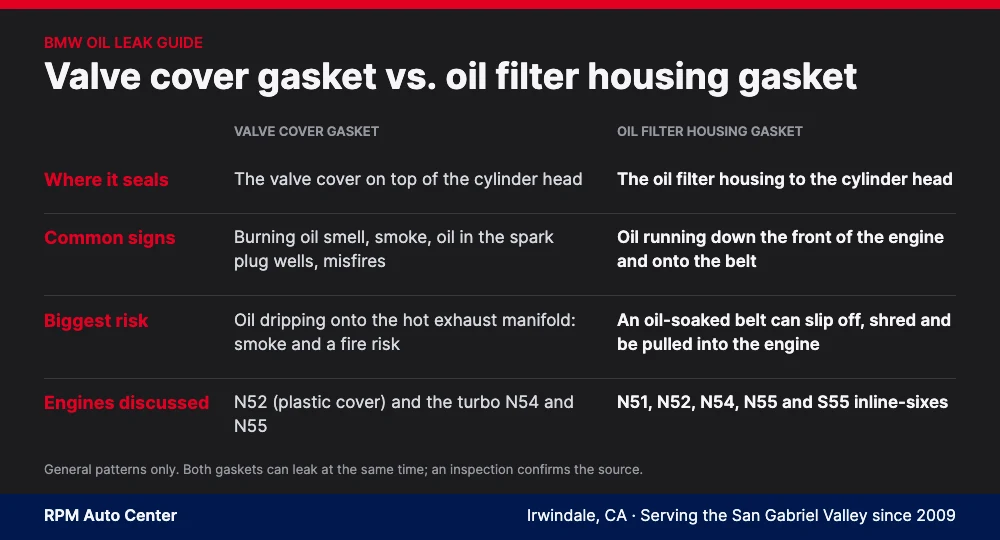
Where each gasket seals, the signs it is leaking and the biggest risk if you wait.
Valve cover gasket leak
Where you see it: oil along the top and sides of the engine, sometimes in the spark plug wells.
What you notice: a burning oil smell, light smoke and, if oil reaches the plugs, a rough idle or misfire.
Oil filter housing gasket leak
Where you see it: oil at the front of the engine, on the timing cover, crank pulley and serpentine belt.
What you notice: oil on the belt and, in a bad case, a belt that slips or comes off.
What Are the Signs of a BMW Oil Leak?
The most common signs of a BMW oil leak are a burning oil smell, smoke from the engine bay, a rough idle or misfire, a belt that slips, and an oil level that drops between oil changes even though there is no puddle in the driveway.
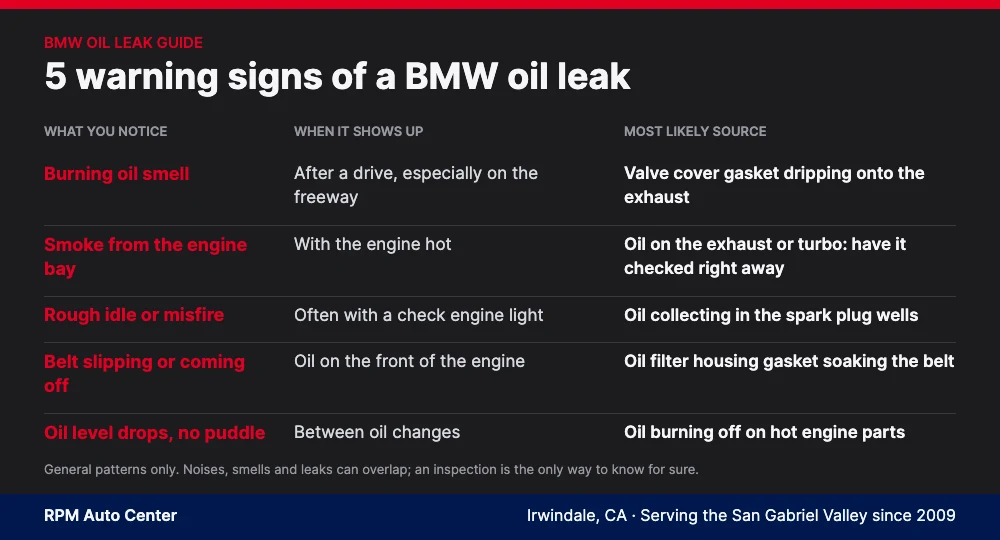
Five BMW oil leak warning signs, when they show up and the most likely source.
Burning oil smell
Usually strongest after freeway driving, when leaked oil lands on the hot exhaust manifold or turbo.
Smoke from the engine bay
A sign that oil is burning on hot parts. Treat it as urgent, since it is a fire risk.
Rough idle or misfire
Oil collecting in the spark plug wells can foul the plugs and ignition coils.
Belt slipping or coming off
Oil from the filter housing gasket can soak the serpentine belt until it slips off its pulleys.
Low oil, no puddle
Oil can burn off on hot parts before it ever reaches the ground, so the dipstick or dash warning is your clue.
Is It Safe to Drive With a BMW Oil Leak?
A small BMW oil leak is not an emergency, but it is not something to ignore either. A small leak almost always gets worse, and the two most common BMW leaks put either the exhaust or the belt in the path of the oil.
Don’t wait
FCP Euro: a small oil filter housing leak “almost always gets worse.”
If you notice a leak:
- If you see smoke from under the hood, pull over safely and shut the engine off.
- Check the oil level and top it off to the correct mark so the engine is never run low.
- Look at the front of the engine for oil on the belt. If it is there, book an inspection right away.
- Topping off keeps the level safe, but it does not stop oil from reaching the exhaust or the belt.
How an Oil Filter Housing Leak Damages the Engine
On the N51, N52, N54, N55 and S55 inline-six engines, a leaking oil filter housing gasket can do far more damage than the leak itself. Here is how a worn gasket can turn into a major engine repair:
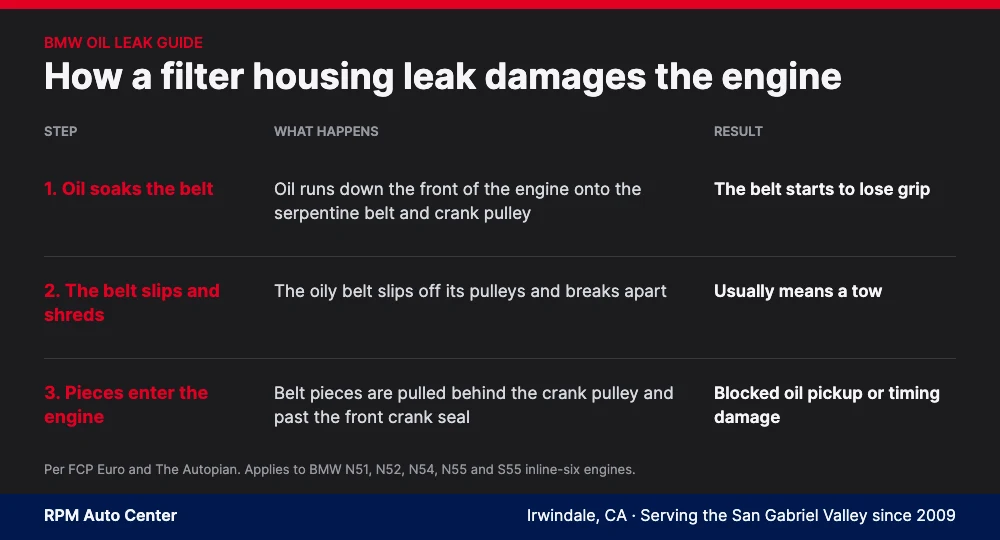
How an oil filter housing gasket leak can go from a drip to engine damage.
Oil soaks the belt
Step 1. Oil runs down the front of the engine and coats the serpentine belt and crank pulley.
The belt slips and shreds
Step 2. An oily belt can slip off its pulleys and break apart instead of simply falling off.
Pieces get into the engine
Step 3. Belt pieces can be pulled behind the crank pulley and past the front crank seal, where they can block the oil pickup or jam the timing chain.
That is why the fix is worth doing early. Replacing the gasket is a routine repair, while belt debris inside the engine can lead to oil starvation or timing damage. If a belt has already come off, the repair should include checking behind the crank pulley for debris, not just installing a new belt. If you’re not sure when your belt was last replaced, see our guide to the timing belt vs. serpentine belt.
How Is a BMW Oil Leak Repaired?
A good repair starts by confirming where the oil is actually coming from. Oil travels and collects at the lowest point, so the wet spot you see is not always the source.
Find the source
Step 1. We inspect the engine on a lift, trace the oil back to where it starts and check the belt, pulleys and spark plug wells.
Replace what failed
Step 2. We replace the leaking gasket, and the valve cover itself if it is warped or cracked, plus a belt that has been soaked in oil.
Verify the fix
Step 3. We clean the area, run the engine up to temperature and recheck for leaks before the car goes home.
The cost of a BMW oil leak repair depends on which gasket is leaking, your engine, whether the valve cover needs to be replaced and whether the belt or tensioner were damaged. We give you a written estimate before any work starts.
Already been quoted?
Bring your BMW oil leak estimate in and we’ll take a second look at the gaskets, belt and anything else on the list.
BMW Oil Leak Repair in Irwindale
RPM Auto Center has been fixing European cars for San Gabriel Valley drivers since 2009, including BMW owners from Arcadia, Monrovia, Duarte, Azusa and Baldwin Park. Our ASE-certified technicians handle valve cover gaskets, oil filter housing gaskets and other leaks as part of our BMW repair and engine repair services. Repairs are backed by our 36-month/36,000-mile warranty.
Due for service anyway? We can check for a BMW oil leak during your next oil change. And if you’ve already been quoted somewhere else, we offer a free second opinion.
Keep reading
More guides for keeping a European car on the road.
Frequently Asked Questions
Is it normal for a BMW to leak oil?
Oil leaks are common on higher-mileage BMWs, but common is not the same as harmless. The valve cover gasket and oil filter housing gasket wear out with heat cycles, and a small leak usually gets worse over time, so it is worth having any leak inspected.
How can I tell if it is the valve cover gasket or the oil filter housing gasket?
A valve cover gasket leak usually shows up along the top and sides of the engine and causes a burning oil smell as oil hits the exhaust. An oil filter housing gasket leak shows up at the front of the engine, often with oil on the serpentine belt and crank pulley.
Can an oil filter housing gasket leak ruin the engine?
It can. Oil can soak the serpentine belt until it slips off and shreds, and on N51, N52, N54, N55 and S55 engines the pieces can be pulled behind the crank pulley and into the engine. That can lead to oil starvation or timing damage, which is why this leak is best fixed early.
Can I just keep topping off the oil?
Topping off keeps the oil level safe in the short term, and you should never run the engine low. But it does not stop leaked oil from reaching the hot exhaust or the belt, so plan to have the leak repaired soon.
What does a BMW valve cover gasket leak smell like?
Most drivers describe a burning oil smell, often strongest after freeway driving or when the engine is hot. You may also see light smoke from the engine bay. Smoke means oil is burning on hot parts, so have it checked right away.
