


Subaru head gasket problems are one of the best-known issues in the car world, but they don’t apply to every Subaru. Here is which engines and model years are affected, the warning signs of a leak, whether it’s safe to keep driving and what a proper repair involves.
The short answer: the 2.5-liter EJ25 engine, used in many 1996 to 2011 Foresters, Imprezas, Legacys, Outbacks and the Baja, is the Subaru engine known for head gasket problems. Newer FA and FB engines are not known for the same issue. Watch for oil drips under the engine, a sweet coolant smell, a coolant level that keeps dropping and any sign of running hot, and have it checked before it overheats.
What Does a Head Gasket Do?
A head gasket is the seal between the engine block and the cylinder head. It keeps combustion pressure inside the cylinders and keeps oil and coolant in their own passages so they never mix. Subaru’s boxer engine lies flat, with a cylinder head on each side, so every Subaru boxer engine has two head gaskets: one on the left and one on the right.
Seals combustion
Holds the pressure of each power stroke inside the cylinder.
Separates fluids
Keeps engine oil and coolant in their own passages.
Two per engine
One gasket for each cylinder head on a boxer engine.
Because the boxer engine sits low and flat, even a small external oil leak tends to drip where you can see it, which is often the first clue owners notice.
Which Subaru Engines Have Head Gasket Problems?
Subaru head gasket problems are mostly tied to the naturally aspirated 2.5-liter EJ25 engine. If your Subaru has a different engine, the head gasket reputation probably doesn’t apply to it.
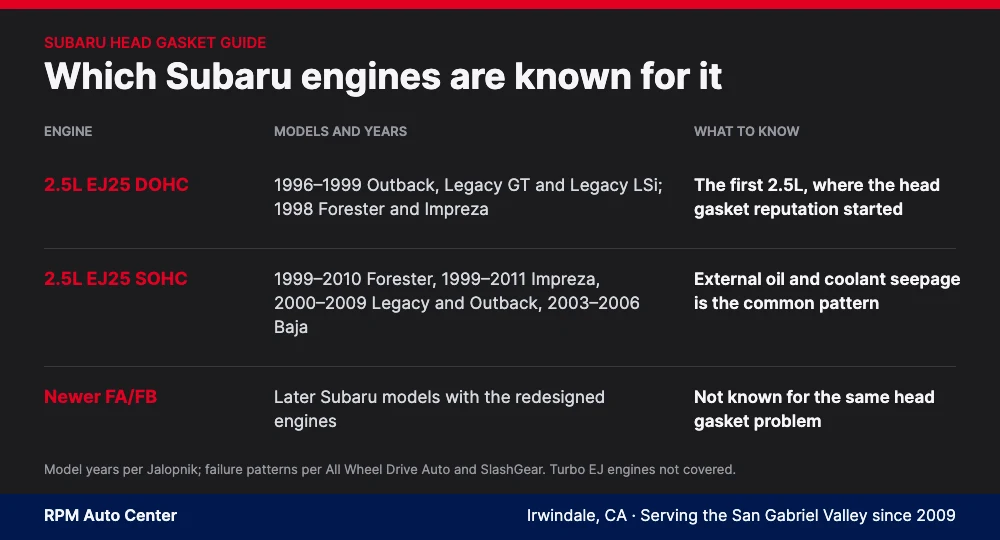
The engines and model years most associated with Subaru head gasket problems.
2.5L EJ25 DOHC
Models: 1996 to 1999 Outback, Legacy GT and Legacy LSi, plus the 1998 Forester and Impreza.
The first 2.5-liter, where the head gasket reputation started.
2.5L EJ25 SOHC
Models: 1999 to 2010 Forester, 1999 to 2011 Impreza, 2000 to 2009 Legacy and Outback, and 2003 to 2006 Baja.
Failures are often estimated at around 120,000 to 150,000 miles.
Newer FA and FB engines
Models: later Subarus with the redesigned engine families.
Not known for the same head gasket problem.
Not sure which engine your Subaru has? It is listed on the emissions label under the hood and in your owner’s manual, or we can look it up from your VIN.
What Are the Signs of a Bad Subaru Head Gasket?
The most common signs of a bad Subaru head gasket are oil drips under the engine, a sweet coolant smell, greenish streaks on the engine, a coolant level that keeps dropping, and an engine that runs hot or overheats.
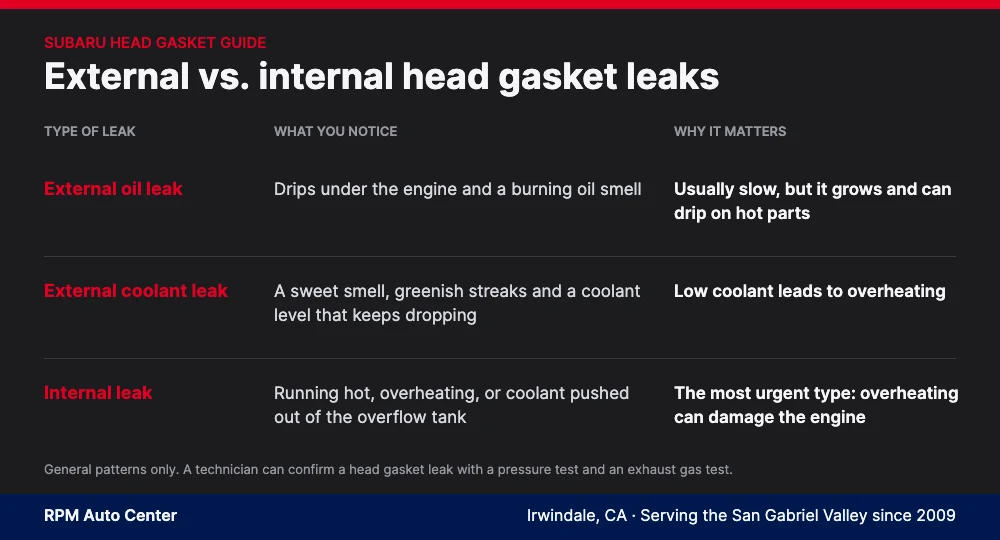
External oil leaks, external coolant leaks and internal leaks each show different signs.
Oil drips under the engine
An external oil leak at the head gasket shows up as drips under the car and sometimes a burning oil smell.
A sweet smell or green streaks
An external coolant leak leaves greenish streaks on the engine and a sweet smell under the hood.
Coolant keeps dropping
If you keep adding coolant and can’t find a puddle, the gasket may be leaking it.
Running hot or overheating
An internal leak can push combustion gas into the cooling system and coolant out of the overflow tank.
One tip: the splash pan under the engine has a fibrous pad that can soak up leaks and hide them, so a proper inspection includes removing it.
Why Did Subaru Head Gaskets Fail?
The original EJ25 head gaskets used a composite material that did not hold up well over time. In 2004, Subaru sent a letter to about 376,000 owners under Service Program WWP-99 and added a coolant conditioner to slow external coolant leaks.
Weak gasket material
Cause 1. The early composite gaskets were prone to seeping oil and coolant as they aged.
Coolant condition
Cause 2. Subaru specialists point to coolant condition as a factor, which is why Subaru added a coolant conditioner.
Heat and overheating
Cause 3. Overheating and poor-quality aftermarket thermostats can damage the gasket, which is why cooling system care matters.
The WWP-99 program extended coverage for external coolant leaks to 8 years or 100,000 miles. That program has ended, so most affected Subarus today are well past any extended coverage.
Is It Safe to Drive With a Leaking Head Gasket?
It depends on the type of leak. A slow external seep can often be watched for a short time while you plan the repair. An internal leak or any sign of overheating is different: keep driving a hot engine and the damage spreads.
Watch the gauge
If the temperature gauge climbs, pull over safely and shut the engine off.
If you suspect a head gasket leak:
- Check the coolant level with the engine cold. Never open a hot radiator cap.
- Keep an eye on the temperature gauge, especially climbing grades like the 210 toward Pasadena or summer stop-and-go traffic.
- Note where you see drips and what color they are, and tell your technician.
- Book an inspection before a small seep turns into overheating.
How Is a Subaru Head Gasket Repaired?
A Subaru head gasket repair is a major job, and doing it right is what keeps it from coming back. Subaru specialists follow a few rules:
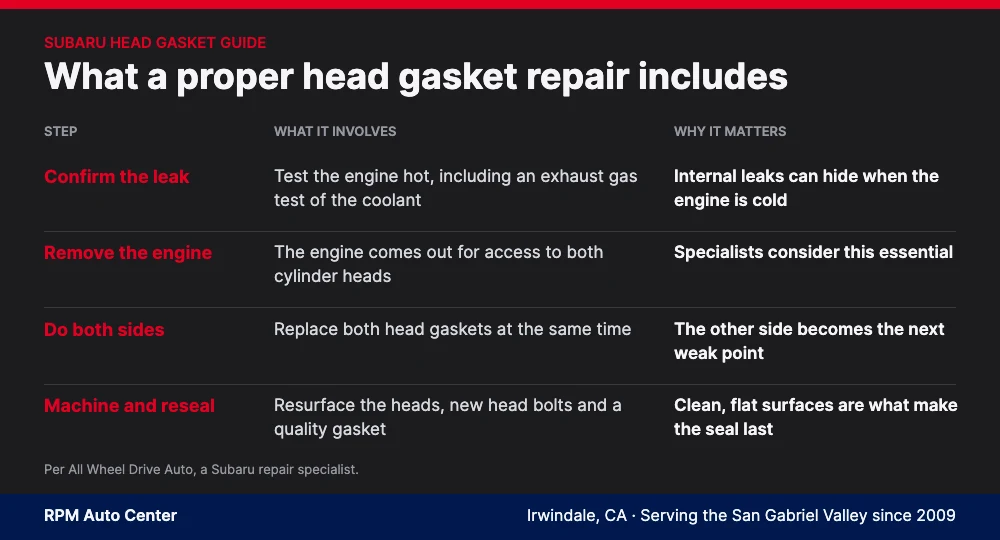
The steps Subaru specialists follow for a head gasket repair that lasts.
Confirm the leak
Step 1. Internal leaks can hide when the engine is cold, so the engine is tested hot, including an exhaust gas test of the cooling system.
Do both sides
Step 2. Specialists replace both head gaskets, since the other side becomes the next weak point.
Machine and reseal
Step 3. The heads are checked and usually resurfaced on later engines, the head bolts are replaced, and a quality gasket is installed.
The cost of a Subaru head gasket repair depends on your engine, how far the leak has gone, whether the heads need machining and what else should be done while the engine is apart. We give you a written estimate before any work starts.
Already been quoted?
Bring your Subaru head gasket estimate in and we’ll confirm the leak and walk you through your options.
Subaru Head Gasket Repair in Irwindale
RPM Auto Center has been helping San Gabriel Valley drivers keep their Foresters, Outbacks and Imprezas on the road since 2009, including customers from Monrovia, Arcadia, Duarte, Azusa and Baldwin Park. Our ASE-certified technicians diagnose and repair head gasket leaks as part of our Subaru repair and engine repair services. Repairs are backed by our 36-month/36,000-mile warranty.
Not sure the problem is the head gasket? Our diagnostics confirm what is leaking before you commit to a repair. And if you’ve already been quoted somewhere else, we offer a free second opinion.
Keep reading
More head gasket and maintenance guides.
Frequently Asked Questions
Which Subaru years have head gasket problems?
The problem is mainly tied to the 2.5-liter EJ25 engine: the 1996 to 1999 DOHC version in the Outback, Legacy GT and Legacy LSi and the 1998 Forester and Impreza, and the SOHC version in the 1999 to 2010 Forester, 1999 to 2011 Impreza, 2000 to 2009 Legacy and Outback, and 2003 to 2006 Baja.
Do newer Subarus have head gasket problems?
Newer Subarus with the redesigned FA and FB engines are not known for the same head gasket problem as the EJ25. Any engine can develop a leak with age or overheating, but the widespread Subaru head gasket reputation comes from the older 2.5-liter engines.
How long can you drive with a leaking Subaru head gasket?
There’s no safe number of miles. A slow external seep may be watched for a short time if the coolant and oil stay full, but an internal leak or any overheating needs attention right away, since running hot can damage the engine further.
Should both Subaru head gaskets be replaced at the same time?
Yes. Subaru specialists recommend replacing both head gaskets together, because once one side is fixed, the other side becomes the next weak point, and the engine already has to come out for the job.
Does Subaru still cover head gasket repairs?
Subaru’s WWP-99 program extended coverage for external coolant leaks to 8 years or 100,000 miles, but it has ended. Today, post-warranty help is case by case, so most owners pay for the repair themselves.
